


Discover Germany with Careerline Education Foundation!

Unlock education, innovation, and endless job opportunities in the heart of Europe!

In recent years, Germany has become one of the top choices for international students and is now the third most popular destination worldwide. This rise shows Germany’s focus on high-quality education and its friendly atmosphere for students from around the world. Germany is well known for its strong engineering and manufacturing, especially in the car industry. But there is more to the country than these traditional strengths.

Information On Your Fingertips

Why Germany is popular in Indian students?

Popular cities to study in Germany

Public and Private Universities in Germany

Germany is recognized for its collaborative approach between schools and organizations, supported by government funding. Like other countries in Germany, the institutes are divided into two categories: public and private. Both are known for their exceptional education approaches, but the choice will depend on an individual’s budget, career objectives, and the demands of the admission process.

Public university is the first priority for international students, because of its lower tuition fees and academic excellence.  Germany has 313 public universities out of 428, and the cost of studying in these institutions will be zero or low.  Admission to public universities is highly competitive due to the large number of international applicants. Earning a degree from a German public university prepares graduates to be job-ready and meet industry standards.

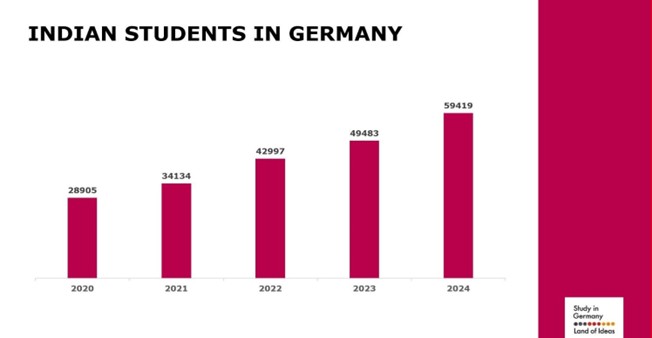
TU9 universities are popular among the international students, but it is the first priority of Indian students because since these technical universities are funded by the German government, and known for technical, innovation, engineering courses. According to recent data, about 49,000 Indian students are studying at TU9 universities and universities of applied sciences in Germany. Indian students make up the largest group of international students in the country.

Admission Process for international students.

1. Choose a Program and University

2. Check Eligibility Criteria

Ensure that you, as an aspirant meet the specific requirements for the chosen program, including academic qualifications and language proficiency.

3. Prepare Application Documents
4. Application Submission
5. Await Admission Decision

Visa Process

Major intakes in Germany

No. Intakes           Start Date Application Opens Application deadline
1 Winter October/November December Mid-January
2  Winter March/April May Mid-July

Financial aid to international students

Types of Scholarships: Germany grants several scholarships to Indian students through various organizations. Indian students can apply for these scholarships and receive financial aid given they meet the eligibility criteria. The major types of scholarships in Germany are as follows:
1. University-Funded Scholarships: Several German universities provide scholarships for Indian students to study in Germany. These scholarships are available for all academic levels, such as UG, PG, and PhD. Every university will have a different set of eligibility criteria and scholarship value.
2. Non-Government Scholarships: Several organisations in Germany offer scholarships to Indian students. The eligibility criteria for these scholarships vary depending on the host institution. Some of the notable scholarships in this category include Heinrich Boll Foundation Scholarships, Bayer Foundation Awards, Friedrich Ebert Foundation scholarships etc.
3. Government Scholarships: The German government provides numerous scholarships for Indian students. These scholarships are provided based on the financial condition of the students. Some of the popular Government-Funded scholarships in Germany are DAAD Scholarship, Erasmus Scholarship Program etc.

Major industries in Germany

With an unemployment rate of just 3.5%, Germany stands out as one of Europe’s leaders in job stability, as reported by the German Federal Statistical Office.
Overview of major industries in Germany
Germany faces a shortage of skilled workers because its population is aging and fewer children are being born. By 2035, the country could be short by 7 million skilled professionals. Meanwhile, India’s workforce is young and well-educated, with more than 1 million people joining the job market each month. This growth positions India as a strong partner to help Germany fill its workforce gaps.
The number of Indian professionals in Germany has increased a lot, rising from 23,000 in 2015 to 137,000 by early 2024. With new steps in the “Focus on India” plan, this number is likely to keep growing.

Cost of studying in Germany​

Approximate For public university:

(Please note that INR conversions are estimates and can change depending on currency exchange rates.)

Work options during study in Germany

Post study work permit in Germany

Post-study work visa (18 months): After you finish your studies, you can apply for a post-study work permit. This permit lets you stay for 18 months to look for a job. While searching for a job in your field, you can work in other sectors if needed. After you employed then you can apply for an EU blue card for continued stay and work in Germany.

Permanent Residency
Permanent residency (PR) may be obtained after 33 months. Applicants with proficiency in the German language may apply after 21 months.
Average Salary
Average Gross Salary = €55,000 (Annual Approx.)
Top 10 In-Demand Jobs in Germany for Skilled Professionals: 2025-2026
Germany still has a shortage of skilled workers, which means there are many opportunities for qualified professionals from India.
Job Profile Average Starting Annual Salary (EUR/INR) *Exchange rate varies, see current rates.
Software Developer (IT/Tech) €58,000
Data Scientist / Analyst €65,000
Electrical Engineer €60,000
Mechanical Engineer €59,000
Civil Engineer / Construction Manager €57,000
Medical Doctor €70,000
Nurse & Elderly Care Professional €45,000
Renewable & Green Energy Engineer €62,000
IT Security Specialist €68,000
Project Manager (Engineering/IT) €66,000

Frequently Asked Questions (FAQs)

  • What are the part-time jobs available in Germany for international students?
    International students are allowed to work (On Campus/Off Campus) for 20 hours per week while studying and full-time in semester breaks. Part-time jobs in Germany can pay well, especially if you work as a tutor, student assistant, office assistant, or library assistant. These roles usually offer hourly wages between €10 to €17.
  • Without knowing the German language, can a student get part-time jobs?
    Yes, international students can find jobs without knowing German, but it would be difficult. Competition is higher among international students. Students with German language skills get the jobs faster and are entitled for higher wages as compared to students having no German Language skills.
  • Can I settle in Germany?
    Yes, you can settle in Germany. After you finish your education, you have 18 months to find a job. Once you are employed, you can apply for a blue card. Later, you may apply for permanent residence after either 21 or 33 months.
  • Can a student work 40 hours in Germany?
    International students in Germany can work up to 20 hours per week during studies. In semester breaks, you can work up to 40 hours per week.
  • Is IELTS mandatory for studying in Germany?
    Yes, you need IELTS/TOEFL if you are applying to English-taught programs. However, if you know German well and are applying to a program taught in German, you do not need IELTS/TOEFL.
  • Germany is known as the home of the automotive sector, and what about the other sector job opportunities?
    AI & Data Science, Robotics & Automation, Healthcare and Medicine, Finance and Fintech, Digital Marketing, Sustainable and Green Energy, Supply Chain and Logistics, Electrical Engineering, Industrial Engineering and Management are among Germany's most emerging and in-demand sectors.
  • What is a blocked account, and why is it mandatory?
    A blocked account is a special bank account you need to study in Germany. It shows you have enough money (about €11,904 for 2025) to cover your living costs while you are there, and it is required to obtain an academic visa.
  • Being an Indian student, is it worthwhile to pursue higher education from German institutes?
    Absolutely! With its world-class education, rising opportunities for global talent, and affordable lifestyle, studying in Germany in 2025 is an ideal step toward a bright future and personal growth.

The journey to your dream
university begins here & now.

Students and Experts Love Us

Book A Free Counselling

Book Appointment

    Request A Call Back

      Book A Free Counselling